Notes/Design
Is Design Cooked?
I spent last winter break wondering whether design was cooked. A year on, the work has completely changed. Time stopped being the constraint, and static design keeps losing value to solving problems.
 Ted Kulakevich·7 min read·8 min listen·
Listen to note
Ted’s voice, read by AI.
The industry is evolving, and things are changing fast. What used to take months now takes days. What used to take years now takes months.
Most people don't realize how quickly it's happening, because day to day, life is busy. You wake up and fall into your patterns. You brush your teeth, work out, grab your coffee, and drive to work with your favorite podcast on. Then you get to work in your tools.
Lunch comes around, you take a break, and you read some headlines. Then you go back to work. Day by day, week by week, month by month, your life doesn't change much.
But the world and the tools around you are changing fast. It's something I've been thinking about all year.
Last winter break
Going into winter break last year, we'd just had our first year of actually using AI every day in our workflows. We used it to generate imagery and help with design, but I was still doing most of the work in Figma by hand.
And I remember thinking, am I cooked? Is design cooked? How long do I have? Do I need to go into construction, or some other physical job?
I spent that whole break wondering.
Then I came back to work, everything got busy, and I put my head down. Life goes on.
But as I've used more of these tools to build personal apps and games, I can really see how fast this technology is advancing and how much is actually changing. Not just the tools themselves, but the workflows.
So every few months this year, I'd wake up out of my routine, so to speak, and look around. Man, these tools are getting better and better. And looking back at my own workflow, I could see it changing.
For about ten years, everything I designed, I designed by hand. I started using Figma around 2017, back when it was still really early. From then until about a year and a half ago, it was all mouse and keyboard. Drawing squares, building logos, creating websites and illustrations.
As AI keeps getting better, my work naturally changes with it. It gets molded around whatever's most productive and works best.
Married to the process
I think the biggest issue in the design space right now is that people are married to their workflows. They're married to their process, to how they do things. And they're married to creating art instead of solving problems.
As a designer, I totally understand. You want to look at your work like a beautiful art piece that belongs in a museum. You want everybody to pat you on the back and respect how much time it took.
Unfortunately, things are a little different in the business world. When companies hire us, they couldn't care less how much time you spent on the solution.
What they care about is, does it solve their problem? Will it help them make more money? Will it reach the users it's supposed to reach? Those are the main things clients care about.
Sure, it's great when you have all this work and iteration to show the client. You can tell a beautiful story and sell them on a brand. That's great.
But at the end of the day, my workflow is changing for one reason, and it's the same for anyone paying attention to where this space is going. AI can do it really fast. Time just isn't the constraint it used to be.
So if you value yourself on how long you can work, or how many iterations you can do by hand, building wireframes and flat designs in Figma, that's slowly losing value. What's gaining value is the ability to solve bigger and bigger problems, fast, using AI.
One thing I just want to tell my designer friends is this. It doesn't matter what tools you use. It doesn't matter how long you spent on it. What matters is, does it serve its purpose? Does it work for the client? Does it make the client more money? If you can answer yes, it works.
Now, if you want to sit all day pushing pixels, building wireframes in Figma, spending an hour on a call to review them, and taking four weeks to lay out a few frames of a homepage, that's totally fine.
But if you want job security, whether you're a freelancer or in-house at a large company, right now is the chance to learn these tools. Build workflows that make you more efficient and cut out the unnecessary work being done at your company.
We all know what every CEO cares about right now. How do we automate? How do we save money with AI? How do we make our company better with AI?
So if you're in-house and you want job security, start building these tools. Start finding ways to automate things. Be interested in AI.
I know a lot of people have an aversion to it. But that doesn't serve you or the company you work for. Find tedious, repetitive tasks that are wasting your time being done by hand, find ways to reverse engineer and automate them, and you'll already be in a better spot.
My workflow now
Corporations are moving fast, but the freelance world moves even faster. Like I said, I used to spend 99 percent of my time in Figma, all day, every day. I'd ship static designs and hand them off to a developer who'd build them.
Now the work has completely changed. Here's my current workflow, and hopefully it inspires some of you.
Let me start by saying I have no idea how to code. The only code I've ever written was an HTML and CSS crash course about twelve years ago.
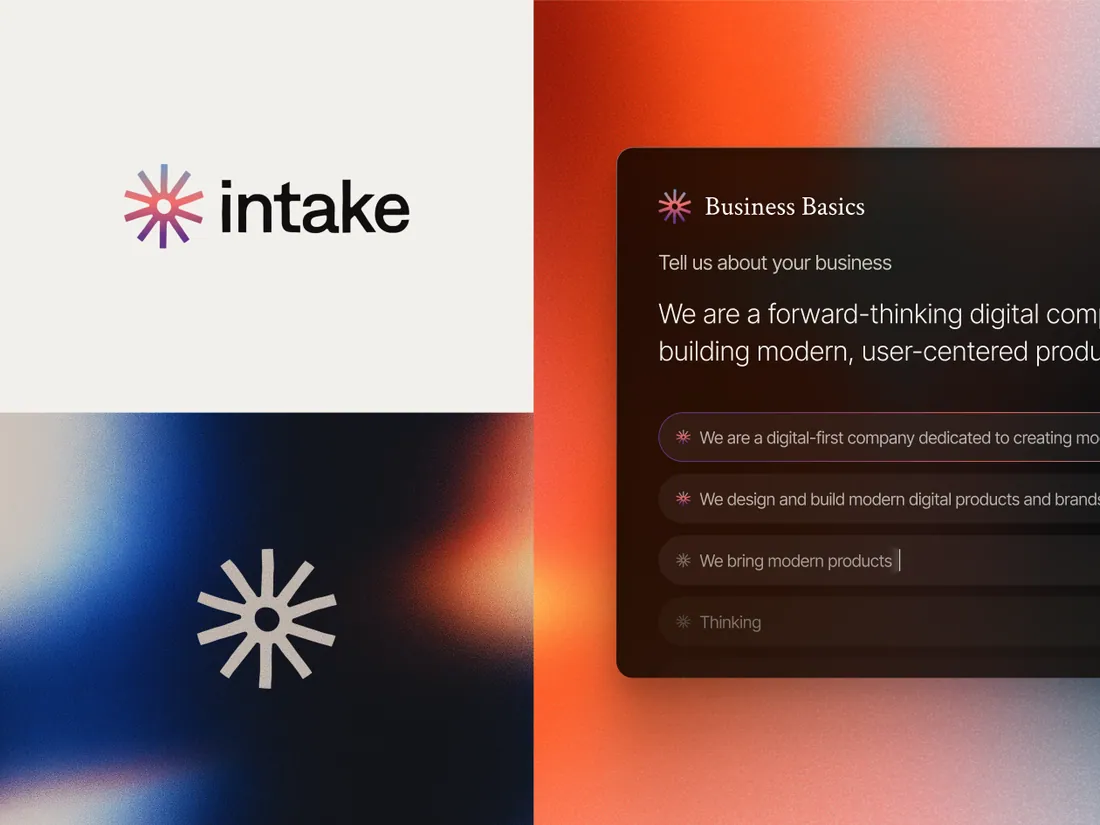
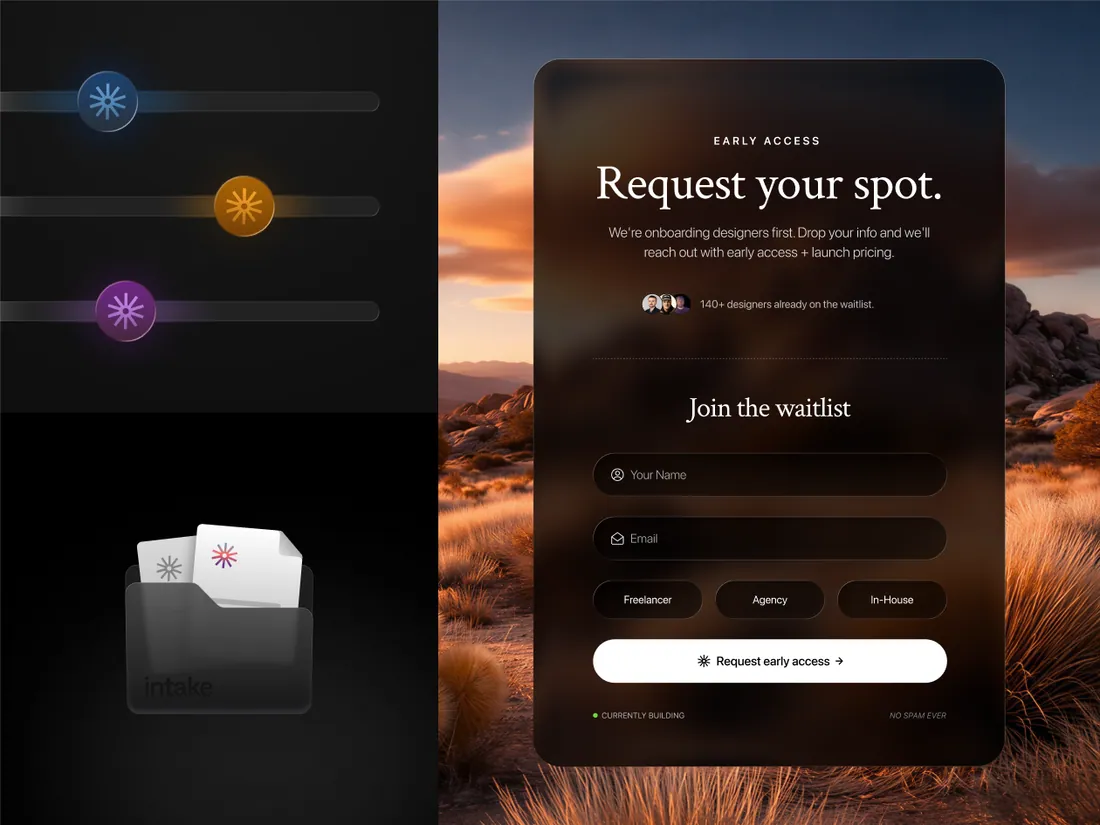
When I get a new project, I start with a tool called intake, at intake.design. It captures client onboarding and uses AI to help the client fill out the form in more detail.
Once I have that document, I give it to Claude or ChatGPT, depending on what I'm working on, and we start on the brand. I do logo explorations and take the best ideas into Figma.
Sometimes I'll do something by hand. Or I'll pull out a notebook or my iPad and draw over whatever was generated. I go back and forth a few times until I have five or six logo directions I think could work.
After I have the logos vectorized, I use AI to help me build a presentation deck using the content from the intake form. Then I present a strong use case based on the information in that form. I tell the client, this is the solution because of what you wrote in your intake.
And then the branding's done. Sometimes it takes a week, sometimes a little longer, but I try to keep branding quick and effective. I avoid adding a bunch of little extras the client doesn't really benefit from.
Once the branding's done, I take the brand document I put together and set up a project in Claude. That's where I build the design system. The logo, the files, the colors, the typography, everything we collected through intake from the get-go.
That gives Claude the context it needs to build the brand, the documents, the website, everything moving forward. The more you can give it up front, the better it'll be.
When it comes to web design, I don't start in Figma anymore. I do the research, then I start prompting and building the site from scratch in code.
Sometimes one version isn't enough, so I'll build three different landing pages, each one a little different, with different colors, graphics, and visuals. I build all of it using AI directly in code.
If I need to do something by hand to get it to that final 10 percent, I'll have Claude or ChatGPT rebuild it as layers in Figma. I jump in, change what I need by hand, and push it back.
Learn the tools
So if you haven't explored using these tools in your workflow, I mean, guys, I don't want to be that guy, but you need to evolve.
I'll go back to that Steve Jobs quote. Stay hungry, stay foolish. Get out there and learn these tools. Keep staying hungry and keep evolving.
AI elevates everybody. Anyone who was terrible at design is decent now, and anyone who was good is great. So a good designer using AI is going to run circles around a good designer who doesn't use it.
I'm not saying it's going to revolutionize the industry overnight. But if you look around, you'll see how the landscape is changing. Static design is going down in value, and solving problems keeps going up.
I don't think of myself as an artist who makes beautiful artwork. I think of myself as a problem solver. And if you think of yourself as a problem solver too, you're setting yourself up to succeed in the years of AI disruption ahead.
Maybe AI does get good enough to one-shot everything and replace us. I still have my reservations. But at least for 2027, if you want to keep growing your business, or build more job security where you are, please learn these tools.
Solve problems. Think bigger. And just prompt.